
Ranges and brass processors
Turn mixed range brass into headstamp-sorted, primer-sorted lots without paying anyone to sit at a table.
Mixed brass in. Sorted by headstamp, primer size, caliber and length out.
Hand-sorting brass is the job nobody wants. AccuSort reads the headstamp on every case with a machine-vision camera, classifies it against a library trained on your own brass, and kicks it into the right bin. Sort by brand, primer size, Berdan or Boxer, caliber, colour and, on the AccuSort 250, case length, at rates from 4,000 to more than 28,000 cases per hour depending on the model.
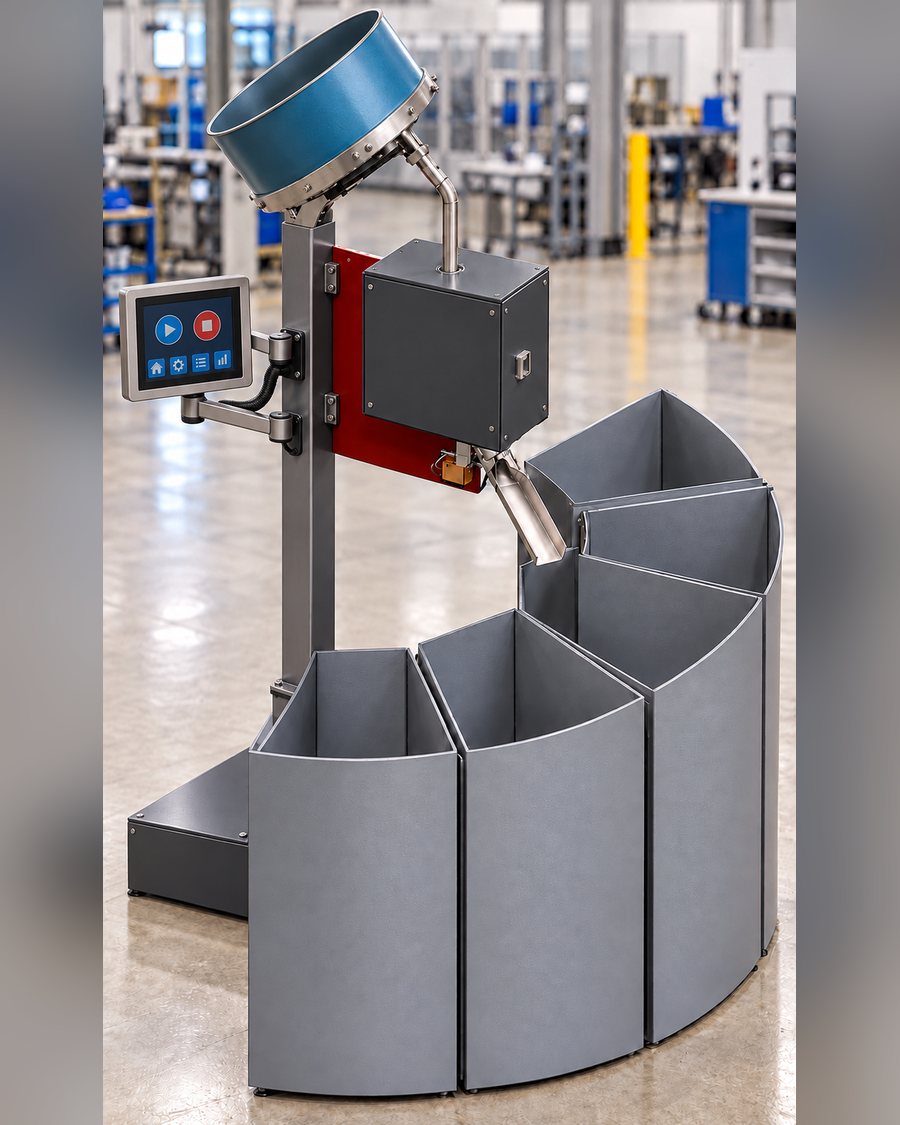
A feeder drops cases one at a time onto a rail. The camera images the headstamp, the software matches it against the library, and an ejector kicks the case into its bin at the end of the rail. A headstamp the library has not seen pauses the machine for the operator, and the library improves as you sort: learning mode first, then automatic. Clean or dirty brass, primed or deprimed, 9mm to .308 length and up to half an inch in diameter. With a well-trained library accuracy reaches 99.9999 percent, one miss in a million; tightening the accuracy target sets more good cases aside for a second look, so you choose the balance.
Four models cover the range. The AccuSort 100 is the first machine for a small operation or a competition shooter, with full credit toward a later upgrade. The 200 is built for uptime: stepper servo, pneumatics and a rotary selector over a ring of bins. The 250 adds a side-view camera so it sorts by case length as well, which separates .300 Blackout from reformed 5.56 and screens trim length. The 300 is belt-fed for the highest throughput when calibers rarely change.
| Model | Throughput | Fit | Delivery |
|---|---|---|---|
| AccuSort 100 | Up to 4,000 cases per hour sustained, about 7,000 tuned | First machine for a small operation or competition shooter; servo kickers into three bins plus a hold for unknown headstamps | 4 to 6 weeks |
| AccuSort 200 | Up to 9,000 cases per hour | Production sorting: stepper servo, pneumatics and a rotary selector over a ring of bins | 4 to 6 weeks |
| AccuSort 250 | Up to 9,000 cases per hour; 10,800 when dialed in | AccuSort 200 plus a side-view camera: sorts by case length too | 4 to 6 weeks |
| AccuSort 300 | Up to 28,800 cases per hour | Belt-fed, one to four spools, three to six bins plus discard; highest throughput when calibers rarely change | 4 to 6 weeks |
Specifications describe standard configurations. Calibers, component sizes and throughput outside these ranges are quoted as custom builds.
Turn mixed range brass into headstamp-sorted, primer-sorted lots without paying anyone to sit at a table.
Sort once-fired brass by headstamp, primer size and caliber before it reaches the processing line.
Keep match brass by headstamp and lot, and screen reformed cases by length.
That is what it does. A camera reads every headstamp and the software matches it against a library trained on your own brass, so the categories are yours: by brand, by lot, by primer size, by caliber. With a trained library it is right 99.9999 percent of the time, one miss in a million.
Dirty brass sorts, at somewhat lower accuracy. Mixed calibers sort in one run within a 2:1 length range (9mm and .380 together, for example); beyond that, pre-sort by size with a trommel or slotted basket first.
They are caught by colour. Some plated cases look like brass to the camera, so a small share can pass as brass.
Start with the 100 if you are trying it out or sorting for yourself; it carries full credit toward an upgrade. The 200 is the production machine, the 250 adds length sorting, and the 300 is for the highest volumes when calibers rarely change.
Calibers, components and volume per shift are enough to start. Standard configuration or a custom build.